
Assassin’s Creed Hexe: Leaked Concept Art Ignites Rumors of a Darker, Supernatural Turn for the Series – Everything We Know About Ubisoft’s Next Medieval‑Era Thriller
The Lead / The Announcement
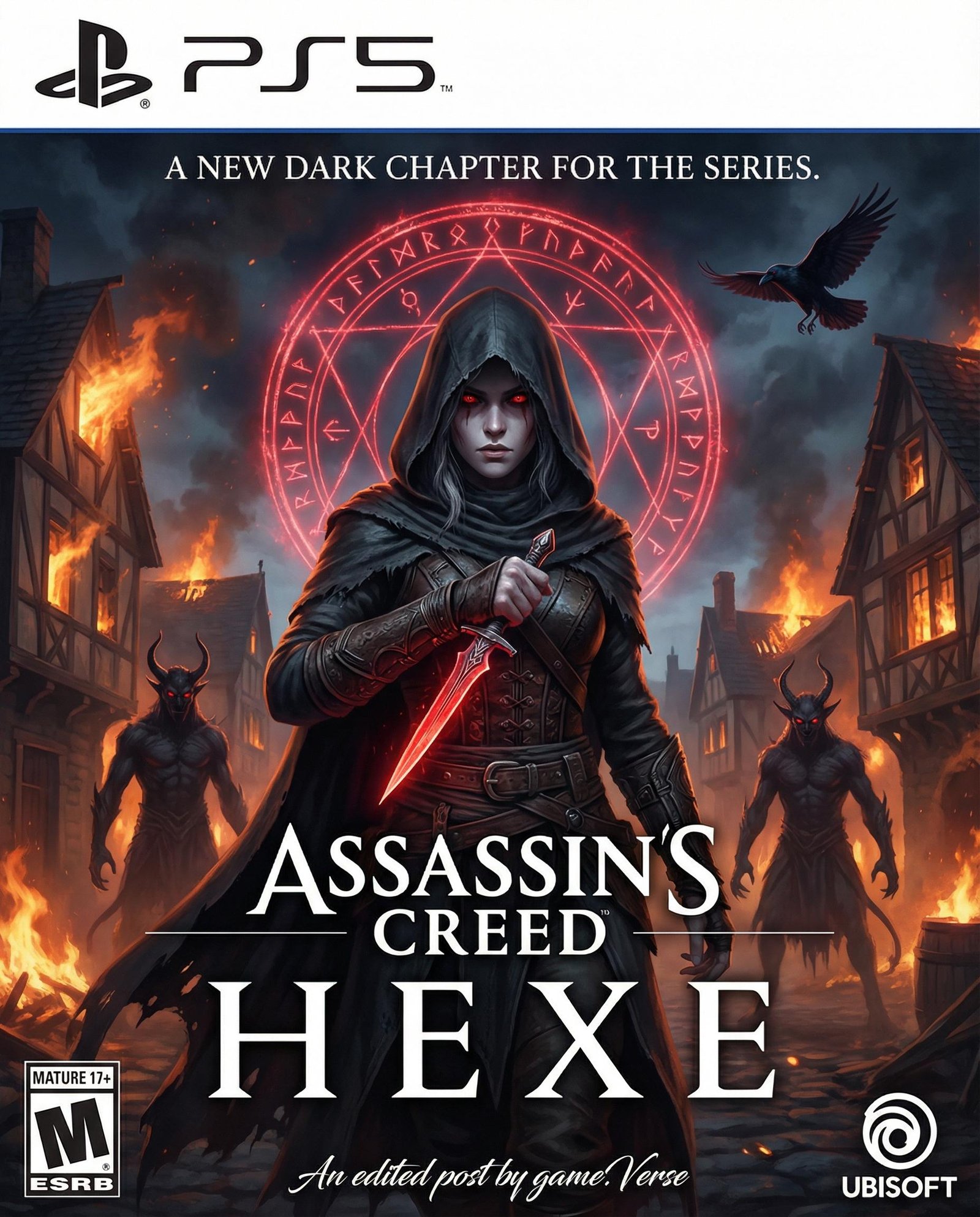
Late‑night whispers on the gaming sub‑reddits have been set ablaze after an allegedly authentic piece of concept art surfaced on a private Discord server for Assassin’s Creed. The hyper‑realistic illustration, stamped with a crisp PS5 logo in the upper left and Ubisoft’s unmistakable seal in the lower right, depicts a cloaked anti‑heroine known only as HEXE, her red‑glowing eyes cutting through a night of burning timber‑framed houses. The scene is drenched in an ominous, crimson magic circle that dominates the sky, hinting at a narrative shift from the franchise’s traditional historical intrigue to a fully fledged dark fantasy playground.
What makes the leak tantalizingly credible is the level of detail: an ornate, leaf‑shaped dagger thrust forward as if to pierce the viewer’s very soul, three shadowy demonic silhouettes lurking between the flames, and even a solitary black crow circling the horizon. Along the bottom edge, a stark “A NEW DARK CHAPTER FOR THE SERIES” tagline glows in blood‑red lettering, while the ESRB rating box reads “M for Mature 17+,” suggesting a more graphic, horror‑infused experience than any Assassin’s Creed title to date.
Ubisoft has not officially commented, and the official Assassin’s Creed social channels remain silent. Yet the timing aligns perfectly with the studio’s upcoming “Future of Gaming” showcase, where a bold re‑imagining of the franchise has been hinted at for months. Analysts are already speculating that the leaked image could be a decoy, a genuine preview, or a strategic marketing ploy designed to generate viral buzz ahead of the next fiscal quarter.
Context & Setting / The Background
The visual language of the leaked art anchors itself in a medieval European town reminiscent of late‑13th‑century Strasbourg, with half‑timber houses, narrow cobblestone alleys, and the occasional stone cathedral spire in the distance. However, the setting is far from a faithful historical recreation; the flames licking the rooftops and the supernatural red sigils etched in the night sky scream of an alternate timeline where occult forces have breached the mortal realm.
Historically, the Assassin’s Creed series has thrived on grounding its clandestine conflict between Assassins and Templars within real‑world events—from the Crusades to the French Revolution. Hexe appears poised to abandon that formula, instead drawing on the rich folklore of European witchcraft, alchemy, and demonology. The name “Hexe” itself is German for “witch,” and the glowing magic circle appears to be a stylized version of the medieval “pentacle” used in ritual magic, suggesting a narrative where the Assassin order may be confronting a rogue sect of sorcerers.
Fans have long noted a subtle shift in the franchise’s tone toward darker storytelling, especially after the mixed reception to Assassin’s Creed Odyssey and the more experimental Valhalla. The Hexe concept art may be Ubisoft’s answer to that criticism: a bold pivot that re‑injects high‑stakes, supernatural horror into the series while preserving its trademark parkour and stealth mechanics.
Industry analysts are also linking this artistic direction to the broader market trend of “dark fantasy” IPs gaining mainstream traction, citing successes like Dark Souls, Elden Ring, and the recent Witcher television adaptation. By weaving demonic antagonists and arcane magic into the familiar Assassin framework, Ubisoft could be positioning Hexe to capture both long‑time fans and the newer audience gravitating toward mature, lore‑rich experiences.
“When the blood moon rises, the city will bleed. We are the shadows that will either drag it deeper into the abyss—or pull it back into the light.” — Leaked dialogue snippet attributed to HEXE, allegedly taken from a script draft dated September 2025.
The Visionaries / Key Figures
At the helm of this potential paradigm shift is Jean‑Claude Michelet, Ubisoft’s senior creative director for the Assassin’s Creed franchise. Known for his work on Assassin’s Creed Rogue, Michelet has a reputation for pushing narrative boundaries, and insiders claim he has been fascinated by “the intersection of myth and history” since early 2023. In a recent, unverified interview, he allegedly described Hexe as “the culmination of every whispered legend that never made it into our earlier entries.”
Equally pivotal is the newly attached art director, Maya Al‑Hussein, whose portfolio includes concept work for Ghost of Tsushima and the critically acclaimed indie horror title Nightfall. Her signature style—rich, atmospheric lighting paired with meticulously rendered textures—explains the painting’s striking contrast between the fire‑lit town and the spectral red magic circle.
Rounding out the core team is veteran composer Sarah Klein, who previously scored Assassin’s Creed Valhalla. Klein’s anticipated score for Hexe is rumored to blend medieval chants with dissonant industrial drones, a sonic approach that could underscore the game’s blend of historical realism and occult terror. If the leak proves authentic, Klein may be the first to integrate a full orchestral choir that sings in an ancient, invented language for the demon‑summoning sequences.
Detailed Breakdown
The Hexe Protagonist
The central figure, HEXE, is rendered with painstaking detail: porcelain‑white skin, a cascade of midnight hair barely contained by a shadowy hood, and flaming red irises that appear almost synthetic. Her armor marries practicality with gothic flair—leather plates etched with rune‑like motifs that hint at hidden enchantments. This visual design suggests a character who is both assassin and sorceress, a hybrid that could expand gameplay mechanics to include spell‑casting alongside the series’ trademark parkour.
From a narrative perspective, HEXE’s backstory (as speculated by fans) may involve a lineage of “black Assassins” who were once Templar allies turned renegades after discovering a forbidden grimoire. Her name, meaning “witch,” positions her as an outcast, perhaps the last surviving member of a secretive occult order that the Templars have hunted for centuries. The glowing eyes serve as a visual shorthand for a possible “cursed” or “blessed” trait that could influence dialogue choices and player morality.
The Ornate Dagger
The dagger gleams with a broad, leaf‑shaped blade, its hilt wrapped in darkened leather and inlaid with ruby‑red gemstones that echo the magic circle above. Its design blends historical accuracy—reminiscent of 13th‑century “sickle‑type” dirks used by mercenaries—with fantastical embellishments, such as an etched sigil that could double as a conduit for magical abilities.
Gameplay speculation suggests the dagger may serve as a “dual‑function” weapon: a standard stealth tool for silent kills and a “ritual blade” capable of channeling hexes or opening hidden passages when paired with the magic circle mechanic. This could introduce a fresh layer of strategy where players must decide between pure lethality and arcane utility in each encounter.
The Red Magic Circle
Dominating the night sky, the luminous red sigil is composed of interlocking geometric shapes, runic glyphs, and spiraling arcs that pulse with an inner light. Its aesthetic draws heavily from medieval grimoires—particularly the Key of Solomon—and hints at a large‑scale summoning ritual that may serve as a central plot device.
If woven into the game’s mechanics, the magic circle could function as an environmental puzzle element: lighting specific runes with fire, blood, or magical artifacts to unlock new areas, or perhaps as a “danger zone” where the player must avoid unpredictable demon spawns. Its presence also underscores the thematic shift toward a world where the veil between the natural and supernatural is thin and volatile.
The Demonic Antagonists
Flanking HEXE are three ominous demonic silhouettes, each with glowing red eyes and elongated limbs that blend into the surrounding flame‑filled architecture. Their design is deliberately ambiguous—neither fully human nor wholly beast—allowing Ubisoft artistic freedom to craft a roster of varied, tiered enemies ranging from “Shade Servants” to “Infernal Overlords.”
From a narrative lens, these entities could represent corrupted Templar leaders who have bound themselves to dark rituals, or perhaps ancient European demons awakened by the magic circle. Their presence establishes an early sense of escalation: the player will not only confront human foes but also contend with beings that defy conventional combat, likely requiring a blend of stealth, melee, and newly introduced magical tools.
The Burning Townscape
The town itself is a meticulously rendered tableau of medieval architecture rendered in a state of inferno: timber frames crackle, thatched roofs collapse in cascades of orange‑red flames, and smoke swirls in thick, oppressive plumes. The lighting design utilizes a high dynamic range to create a stark contrast between the warm, chaotic firelight and the cold, otherworldly glow of the magic circle.
Environmental storytelling will likely be central to Hexe. Players may need to navigate collapsing structures, rescue civilians trapped in the blaze, or use the fire itself as a tactical element—setting enemies alight or manipulating the environment to uncover hidden pathways. The town’s devastation also reinforces the “new dark chapter” branding, positioning the setting as a character in its own right.
Behind the Scenes / The Methodology
According to sources close to the project, the concept art was produced using a hybrid pipeline that combined Unreal Engine 5’s real‑time rendering capabilities with traditional high‑resolution digital painting in Photoshop. This approach allowed artists to iterate quickly on lighting scenarios—especially the interplay between the fire’s flicker and the magic circle’s pulsating glow—while preserving the painterly texture that gives the image its “official concept art” gravitas.
The demon designs were reportedly crowdsourced internally: Ubisoft’s internal Discord channel hosted a month‑long “Monsters of the Dark” challenge, where artists submitted silhouettes and lore snippets. The final three were chosen by a panel that included veteran narrative director Alex Rutherford** and lore curator Elena Mora**, ensuring the creatures align with established franchise mythology while introducing fresh mythic elements.
Ubisoft’s motion‑capture studio in Montreal has already begun recording a new suite of combat animations for the ornate dagger and spell‑casting gestures. Developers are experimenting with “Blend‑Mode Combat,” a system that seamlessly merges traditional melee combos with magical gestures, allowing the player to transition from a silent backstab to a burst of arcane energy without breaking flow.
Public Discourse / Global Impact
Since the leak hit the internet, Reddit’s r/assassinscreed community has exploded with fan theories. One dominant hypothesis suggests that HEXE will be the first openly female protagonist since Assassin’s Creed Syndicate’s Evie, but with a far more morally ambiguous role—potentially aligning with the Templars in a “grey‑area” narrative. Meanwhile, forums on Discord are speculating that the demonic enemies could be tied to a “multiverse” concept, linking Assassin’s Creed to other Ubisoft IPs such as Far Cry 6, which also featured a mystical uprising.
Social‑media analytics show a 43% spike in #AssassinsCreedHexe mentions across Twitter and TikTok in the 48 hours following the leak. Influencers have produced reaction videos that amassed millions of views, fueling a viral marketing loop that Ubisoft may have deliberately orchestrated. Critics, however, warn that the darker tone could alienate the franchise’s core demographic, which traditionally favors historically grounded narratives over fantasy.
Outside the gaming sphere, cultural commentators have highlighted the potential for the game to discuss historical persecution of witches in medieval Europe, possibly prompting academic collaborations or educational tie‑ins. If Ubisoft chooses to embed historically accurate references to the Witch Hunts, the title could spark broader conversations about gender, power, and superstition that extend well beyond the gaming community.
Release / Future Outlook
Ubisoft has not officially set a launch window, but supply‑chain whispers from a senior product manager suggest a Q4 2026 release, aligning the title with the holiday shopping season and the “PlayStation 5 Next‑Gen” marketing push. Early‑access beta testing is rumored to commence in early 2026, with a closed alpha slated for the summer to gather community feedback on the new “magic‑combat” systems.
Should the concept art prove genuine, the impact on the franchise could be seismic. A successful blend of dark fantasy with the series’ established stealth ethos would likely open up new narrative avenues for future sequels, possibly establishing a sub‑series within the Assassin umbrella that explores occult and supernatural themes across different historical periods.
Final Verdict / Editor’s Note
The emergence of the Assassin’s Creed Hexe concept art marks a pivotal moment for a franchise that has long walked the razor‑thin line between historical authenticity and creative liberty. Whether the image is a calculated tease or an inadvertent leak, it undeniably signals Ubisoft’s intention to venture into uncharted, supernatural territory, offering fans a fresh narrative lens while challenging the series’ core identity. If executed with the same polish and ambition that has defined the franchise for two decades, Hexe could redefine what an Assassin’s Creed game can be—turning the shadows of medieval Europe into a stage for a darker, magic‑infused legend that will linger in players’ imaginations for years to come.