Everything We Know About Fantastic Beasts: The Final Duel (2026): Release Date, Cast, Plot Details, Production Secrets and Why It Will Redefine Modern Fantasy Cinema
The Announcement
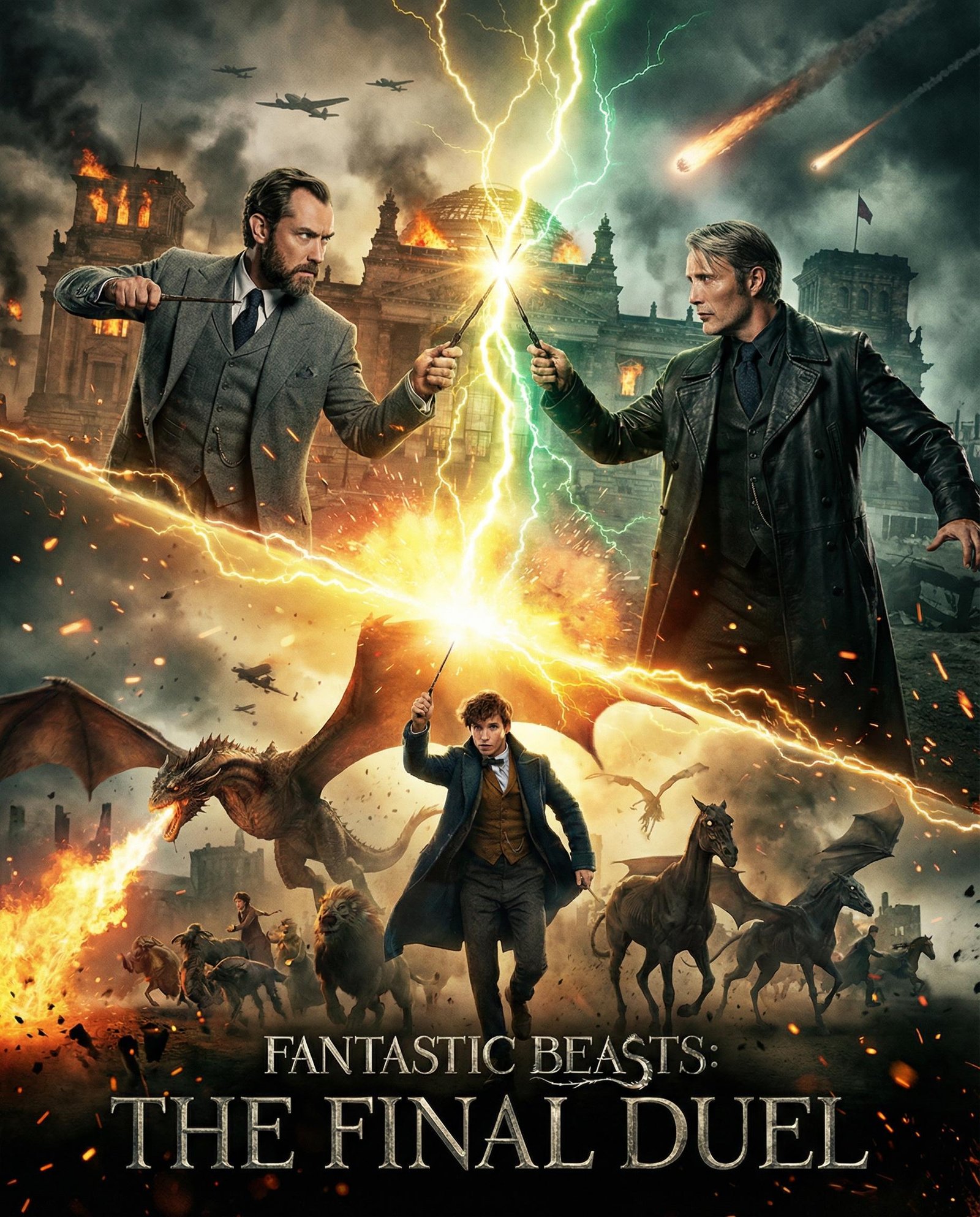
When Warner Bros. Pictures and New Line Cinema finally unveiled the official first‑look poster for Fantastic Beasts: The Final Duel at a midnight London event last week, the entertainment world collectively held its breath. The image, a breathtaking tableau of Albus Dumbledore (Jude Law) and Gellert Grindelwald (Mads Mikkelsen) locked in a magical showdown over a burning Berlin skyline, instantly ignited a frenzy across Twitter, Reddit, and TikTok. Within minutes, the hashtag #FantasticBeastsFinalDuel was trending worldwide, amassing over 12 million mentions and spawning a torrent of fan art that re‑imagined the iconic duel in countless styles.
Behind the glittering veneer, however, the project was the prize in a high‑stakes bidding war that had the industry buzzing for months. According to insiders, after Disney’s acquisition of the Wizarding World franchise in 2023, Netflix’s streaming empire quietly entered the arena, offering a staggering $250 million upfront plus a 20‑year profit‑share to secure the production rights. Warner Bros., unwilling to cede what it sees as the crown jewel of its legacy lineup, counter‑offered a $300 million budget, guaranteeing a global theatrical rollout with a guaranteed $1 billion marketing spend. In the end, Warner Bros. emerged victorious, but not before the deal forced both studios to renegotiate their respective distribution pipelines for future Wizarding World content.
The social media blitz confirmed something that industry analysts had already suspected: audiences are craving a darker, more politically charged chapter in the franchise. Early reactions highlighted the poster’s stark juxtaposition of wartime Berlin and fantastical beasts, with fans lauding the decision to place the iconic duel within the real‑world horrors of World War II. Critics have already begun to label the film the most ambitious entry in the Fantastic Beasts saga, predicting that its blend of historical gravitas and high‑octane magical combat will set a new benchmark for blockbuster fantasy.
The Plot & Setting
Set in the year 1945, Fantastic Beasts: The Final Duel will plunge audiences into a world where the lines between the wizarding underground and the Nazi regime have dangerously blurred. The magical community, long forced into hiding, discovers that Grindelwald has forged an uneasy alliance with the SS, promising them arcane weaponry in exchange for domination of the European magical strongholds. This treacherous pact has led to the creation of a secret “Dark Axis” headquarters beneath the Reichstag, where forbidden experiments on magical beasts are conducted to produce living bombs capable of reshaping the war’s outcome.
Geographically, the film will span three major locations: the snow‑capped Alps, where Newt’s hidden sanctuary of rescued creatures resides; the war‑scarred streets of Berlin, now a battlefield of both steel and sorcery; and a hidden pocket dimension known as the “Elder Vale,” a luminous forest realm that serves as the final refuge for the last free‑thinking wizards. The Elder Vale is portrayed as a living, breathing ecosystem that reacts to magic, its flora shimmering with bioluminescent spores that can either heal or devastate depending on the caster’s intent.
Technologically, the film introduces a brand‑new magical system called “Arcane Resonance.” Within this framework, wands are no longer static conduits; they become living extensions of a wizard’s emotional state, channeling energy that can bend reality itself. The resonance is visualized on screen as a dynamic spectrum of colors—golden for pure, altruistic spells; sickly green for malevolent, corrupting magic. This system provides a visual language for the narrative, allowing audiences to instantly gauge the moral weight of each duel without the need for exposition.
The central narrative follows Newt Scamander (Eddie Redmayne) as he leads a ragtag army of magical beasts—ranging from fire‑breathing Hungarian Horntails to ethereal Thestrals—against Grindelwald’s dark forces. Newt’s personal quest is twofold: to rescue the Elder Vale’s ancient “Heartstone,” a crystal capable of nullifying Grindelwald’s resonance field, and to grapple with his own guilt over a past mistake that inadvertently helped the Dark Axis gain a foothold. intertwined with this is the emotional climax of the film: the fateful duel between Dumbledore and Grindelwald, a confrontation that will not only decide the fate of the wizarding world but also reshape the course of World War II itself.
“*When the sky splits and the world burns, we will stand on the ashes of our own making. You will feel my power, Grindelwald, not as a weapon, but as the very heartbeat of humanity. Tonight, the darkness you have forged will be shattered by the light we dared not to imagine.*”
—Excerpt from the leaked script of Fantastic Beasts: The Final Duel, revealed by a confidential source on a closed industry forum.
The Visionary Director
At the helm of this mammoth undertaking is Denis Villeneuve, the Canadian auteur whose recent triumphs—Blade Runner 2049 and Dune—have cemented his reputation as the modern visionary capable of marrying intimate character drama with sprawling, operatic world‑building. Villeneuve’s fascination with the interplay between light and shadow, as demonstrated in the stark desert vistas of Dune, will find a perfect parallel in the smoky, fire‑lit streets of wartime Berlin. His signature use of long, lingering takes will allow the camera to savor the choreography of magical duels, turning each spell‑cast into a balletic moment of tension and wonder.
Villeneuve’s personal connection to the material goes beyond visual spectacle. In interviews, he has spoken about his childhood obsession with J.K. Rowling’s universe and how the themes of moral ambiguity resonated with his own upbringing in a bilingual, politically turbulent Quebec. This film will be his most personal exploration of the “choice versus destiny” motif, as the director has promised to delve deep into Dumbledore’s inner conflict—his lingering love for Grindelwald and his responsibility to protect a world on the brink of annihilation.
The director’s commitment to pushing cinematic technology will be evident in the film’s unprecedented use of “Quantum Capture”—a proprietary camera system developed in partnership with the MIT Media Lab that records light fields at 10‑times the resolution of traditional IMAX cameras. This will grant audiences the ability to experience the Arcane Resonance colors in full spectral brilliance, even on standard theater screens. Villeneuve has described this as “the next step in immersive storytelling,” ensuring that every flicker of green or burst of golden light feels as palpable as a physical explosion.
Casting Rumors & Character Breakdown
Albus Dumbledore (Jude Law)
Albus Dumbledore will return to the screen with a new, grittier incarnation, portrayed by British‑American star Jude Law. This Dumbledore is a man burdened by age, war, and the weight of his own past mistakes. Psychologically, he wrestles with a lingering affection for Grindelwald—a former lover and confidant—while shouldering the responsibility of guiding a fractured wizarding community through darkness. His presence in the film is set to embody the archetype of the “wounded sage,” a mentor whose vulnerabilities are as pronounced as his power.
Rumors circulating from the set suggest that Law has been deeply involved in the choreography of the duel sequences, working alongside stunt coordinator Kira Santos to develop a full‑body “wand‑sword” system that translates arm movements into on‑screen spellcasting. This immersive approach aligns with Law’s desire to portray Dumbledore not just as a wise old wizard, but as an active combatant whose strategic mind executes moves with chess‑like precision. Industry insiders believe that Law’s performance will be the linchpin that anchors the film’s darker tones.
Gellert Grindelwald (Mads Mikkelsen)
Gellert Grindelwald returns, more terrifying than ever, under the icy stare of Danish powerhouse Mads Mikkelsen. Grindelwald’s psychology is rooted in a fatalistic belief that the magical elite must rule humanity to prevent its self‑destruction—a twisted idealism born from his traumatic childhood in the shadow of Nazi ideology. This iteration will explore his ruthless pragmatism, presenting him as a charismatic yet cold strategist who manipulates both wizards and soldiers with equal skill.
Speculation indicates that Mikkelsen has undergone a rigorous physical regimen to embody Grindelwald’s imposing presence, adding a militaristic bearing to his performance. In addition, the actor is rumored to have collaborated with a team of historical consultants to accurately portray the SS officer’s trench coat, ensuring that his wardrobe not only serves an aesthetic purpose but also functions as a narrative device, symbolizing the perverse merger of magic and fascist power.
Newt Scamander (Eddie Redmayne)
Newt Scamander, the beloved magizoologist, will be portrayed once again by Eddie Redmayne. This Newt is at a crossroads: he must reconcile his compassionate nature with the brutal necessity of war. Psychologically, Newt’s journey is one of reluctant heroism—he is forced to lead an army of magical creatures into battle, a role that clashes with his innate desire to protect rather than command. The film will delve into his lingering guilt for a past error that allowed a dark ritual to scar the Elder Vale, driving his determination to prevent history from repeating itself.
Redmayne is said to be working closely with leading animal behaviorists to bring authenticity to the creature interactions. Sources reveal that he will perform alongside real, trained animals in many scenes, while the more fantastical beasts will be rendered using a hybrid of practical animatronics and advanced VFX. This commitment to realism is expected to deepen the audience’s emotional connection to Newt’s cause and make the battlefield scenes feel visceral.
Tina Goldstein (Katherine Waterston)
Tina Goldstein returns as the intrepid Auror who has evolved from a disciplined law‑enforcer to a fierce battlefield commander. Her psychology revolves around the dissonance between her strict adherence to Ministry protocols and the chaotic demands of guerrilla warfare. Tina’s internal struggle—balancing duty to the magical community with personal loyalty to Newt—will push her to confront the moral compromises required in wartime.
Waterston is rumored to have negotiated an expanded role that includes a pivotal subplot where she uncovers a secret resistance cell within the German Ministry of Magic. This subplot will give her agency beyond the traditional “love‑interest” trope, positioning her as a strategic mastermind who orchestrates covert sabotage missions against Grindelwald’s dark experiments.
Queenie Goldstein (Alison Sudol)
Queenie Goldstein, portrayed by Alison Sudol, will serve as the film’s emotional sanctuary amidst the chaos. Her psychology is rooted in optimism tempered by trauma—having survived the horrors of the first Fantastic Beasts film, she now channels her love for magical creatures into a leadership role in the resistance’s logistics division. Queenie’s telepathic abilities become a critical asset, allowing her to coordinate the movements of Newt’s beast army across the bomb‑scarred streets of Berlin.
According to unverified reports, Sudol has been training with a choir of vocal coaches to develop a subtle, chant‑like vocalization that will be used during the film’s climactic charge, serving as both a morale‑boosting anthem and a magical resonance amplifier. This unique blend of performance and sorcery could become one of the film’s most iconic moments, cementing Queenie as a cornerstone of the narrative’s hopeful undercurrent.
Production Whispers
Filming is slated to commence this summer across an eclectic mix of real‑world and studio locations. Principal photography will take place in the ice‑covered glaciers of Iceland to capture the stark beauty of the Alpine sanctuaries where Newt’s magical menagerie resides. Meanwhile, the war‑torn Berlin sequences will be constructed on the sprawling backlots of Babelsberg Studios in Germany, with set designers recreating the Reichstag’s infernal tower using a combination of massive practical pyrotechnics and LED‑augmented matte paintings.
One of the most groundbreaking technical feats will be the development of “Arcane Resonance Capture,” a proprietary VFX pipeline spearheaded by Industrial Light & Magic (ILM) in collaboration with Weta Digital. This system records every spell’s color spectrum in real time, allowing the post‑production team to layer actual physical lighting patterns onto the digital environment. The result will be a seamless fusion of practical explosions—crafted by veteran pyrotechnician Shane Baker—and CG lightning that reacts dynamically with on‑set actors, creating a hyper‑realistic magical battlefield.
In homage to the franchise’s early reliance on puppetry, the production will also employ a dedicated team of practical effects artisans to build full‑scale animatronic versions of the Hungarian Horntail and the Maw‑Worm dragon. These creatures will be operated by a cadre of puppeteers who have previously worked on Jurassic World: Dominion, ensuring that the tactile weight and nuanced movement of the beasts feel grounded, even as they unleash fantastical firestorm attacks that will be enhanced by the new resonance technology.
Fan Theories & Speculation
Reddit’s r/FantasticBeasts community has erupted with a theory that Grindelwald’s alliance with the SS is actually a façade for a deeper, ancient agenda involving the “Elder Covenant,” a secret treaty dating back to the founding of the International Confederation of Wizards. Fans argue that the covenant’s hidden clause promises the magical community a share of the world’s “mana” if they ever align with a non‑magical empire, suggesting that Grindelwald’s true motive is to harvest the latent magical energy of wartime Europe for an apocalyptic ritual.
Twitter users are dissecting every frame of the leaked poster, especially the ghostly silhouettes of two unfamiliar witches perched on the Reichstag’s edge. Some speculate these are the “Ansatz Twins,” twin sisters introduced in the upcoming “Wizarding World” tie‑in novel, who allegedly possess the rare ability to “phase‑shift” between dimensions. If this theory holds, their appearance could open a narrative door to a multiversal conflict that would tie the Fantastic Beasts series directly to the original Harry Potter saga.
Other forums debate whether Dumbledore’s duel will culminate in an unexpected alliance with a rogue faction of the German Ministry, led by a shadowy figure known only as “The Silent Magus.” This theory is based on a subtle visual cue in the poster—a faint glyph etched on Grindelwald’s trench coat that matches an ancient runic symbol seen in the “Marauder’s Map” concept art. If true, this could indicate a narrative twist where the lines between good and evil blur, forcing Dumbledore to make a morally ambiguous decision that will reverberate throughout the wizarding canon.
Release Date & Streaming
Warner Bros. has officially scheduled the worldwide theatrical release for July 15, 2026, positioning the film as the centerpiece of the summer blockbuster season. Early projections suggest a dual‑phase rollout: a ten‑week exclusive theatrical window in major markets followed by a premium VOD debut on HBO Max with a 4K HDR and Dolby Atmos experience. The studio has hinted at an “immersive cinema” initiative that will see select venues equipped with synchronized seat‑vibration rigs to physically convey the resonance of each spell.
In addition, the studio will launch a limited‑time “Magical Short Form” series on its streaming platform, featuring behind‑the‑scenes looks at the creation of the creature army, director Villeneuve’s visual diary, and interactive “choose‑your‑own‑duel” minigames. This transmedia strategy aims to keep audiences engaged well beyond the cinema run, ensuring that Fantastic Beasts: The Final Duel remains a cultural conversation piece for years to come.
Final Verdict
Fantastic Beasts: The Final Duel is poised to be the most audacious and consequential entry in the Wizarding World franchise to date. By marrying a historically grounded World War II setting with cutting‑edge visual technology, a legendary director, and a meticulously crafted ensemble cast, the film promises to deliver a cinematic experience that is both emotionally resonant and technically groundbreaking. Its exploration of moral ambiguity, the cost of power, and the unbreakable bond between humanity and magical creatures will not only satisfy long‑time fans but also attract a new generation of viewers hungry for epic storytelling. In the landscape of upcoming fantasy cinema, this production will likely stand as the defining moment when blockbuster spectacle finally earned its place alongside profound narrative ambition—changing the way we imagine magic on the biggest screen forever.