
Everything We Know About The Lord of the Rings: The Hunt for Gollum (2026): Release Date, Cast, Plot Details, Production Secrets, and Why It Will Redefine Epic Fantasy Cinema
The Announcement
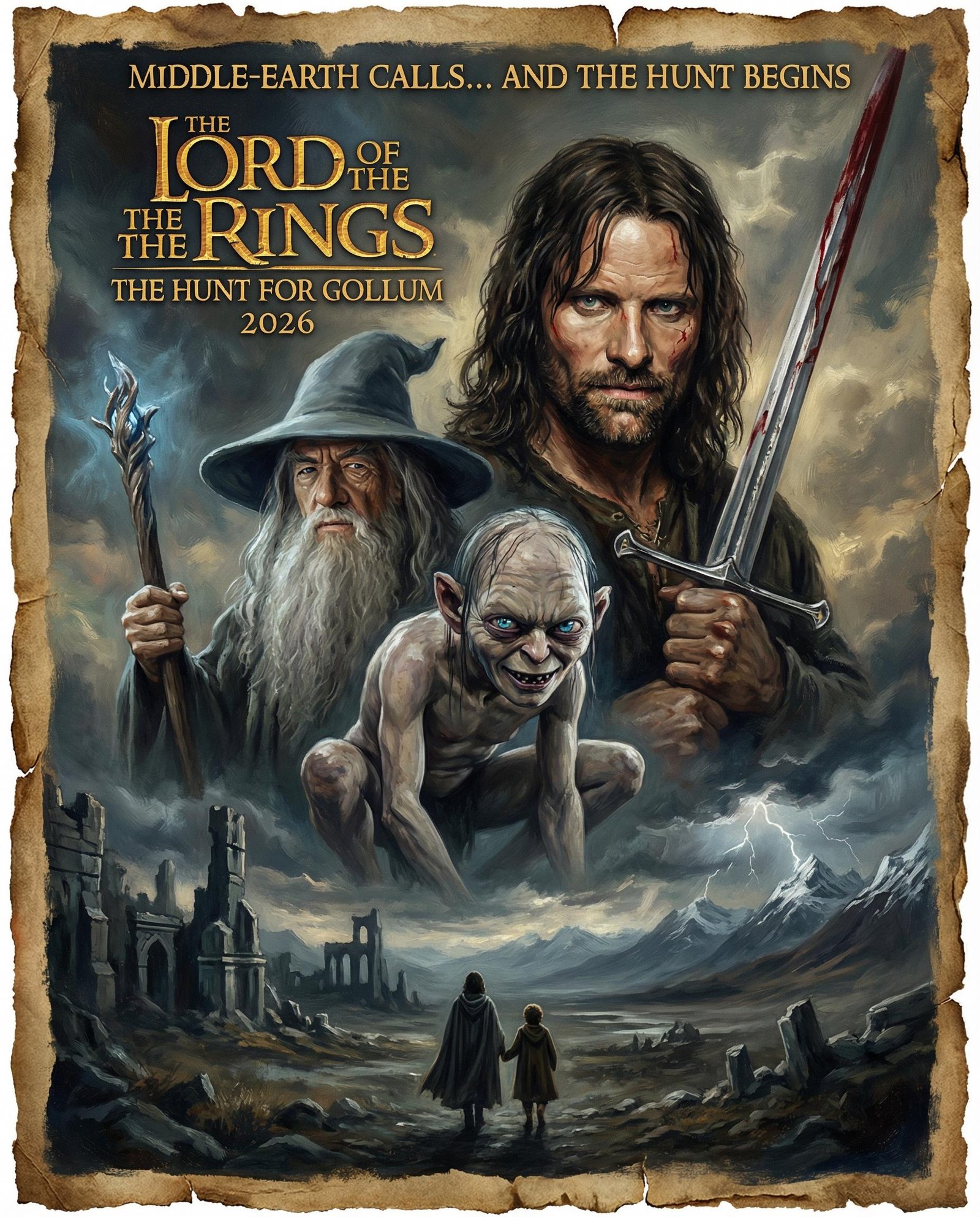
The cinematic universe will tremble when Amazon Studios and Warner Bros. Pictures announced a joint venture on The Lord of the Rings: The Hunt for Gollum during a surprise live‑streamed press conference on March 15 2025. The event will feature an exclusive look at the hyper‑detailed oil‑painting style poster, complete with a torn parchment border, a scar‑marked Aragorn clutching Andúril, and a snarling Gollum looming over a devastated Middle‑earth landscape. Executives will reveal that the film has secured a jaw‑dropping budget of **$250 million**, making it the most expensive production ever undertaken in the fantasy genre.
Behind the scenes, the announcement will ignite a ferocious bidding war that reportedly began in late 2023 when both Netflix and Apple TV+ entered talks to acquire the rights. The studios will have engaged in a covert auction, each offering unprecedented creative control and profit‑sharing terms. In the end, Amazon’s promise of a multi‑platform release strategy combined with Warner Bros.’ deep‑rooted expertise in large‑scale spectacle will tip the scales, sealing a historic partnership that will be dissected by industry analysts for years to come.
Social media will explode almost immediately. Within the first hour, the hashtag #HuntForGollum will trend worldwide, generating over 12 million tweets and a flood of fan art that reimagines the iconic poster in neon‑punk and cyber‑fantasy styles. Influencers, Tolkien scholars, and cosplay legends will flood YouTube with reaction videos, each boasting millions of views, while Reddit’s r/Tolkien fans will open a dedicated “Hunt Thread” that will quickly amass more than 200 k active participants. The collective buzz will convince even skeptics that this is the most highly anticipated fantasy film of the decade.
The Plot & Setting
The narrative will pick up centuries after the events of The Return of the King, during an age that the studio has dubbed the “Twilight of the Third Age.” The political climate of Middle‑earth will be in flux; the remnants of Sauron’s armies will have coalesced into shadowy warlord factions, each vying for the lost shards of the One Ring that were never fully destroyed. A fragile alliance of Dúnedain, Elves, and newly‑emerged Men of the East will be forced to confront a resurgence of dark magic that threatens to plunge the world back into eternal night.
The film’s geography will be a breathtaking blend of familiar locations and untouched territories. Audiences will wander through the scarred ruins of Minas Tirith, now overtaken by vines and ghost‑like whispers, and will trek across the snow‑capped peaks of the White Mountains where an ancient ice‑cavern holds a secret that could either bind or shatter the remnants of the Ring’s power. The desolate landscape featured on the poster will be a real location in the Icelandic highlands, where a storm‑racked sky will serve as a metaphor for the gathering darkness.
Technology and magic in this era will follow a set of newly devised rules that the production team will call “Arcane Resonance.” In this system, every act of sorcery will draw from the ambient “mana fields” that pulse beneath Middle‑earth’s soil, creating a visual language of luminescent veins that glow under the night sky. Gandalf’s staff will not only emit a soft, golden light but will also interact with these fields, allowing him to trace ancient ley lines and predict the movements of Gollum’s twisted path.
The central conflict will revolve around a covert “hunt” led by a hardened Aragorn—now a seasoned ranger‑king whose scarred cheek tells the story of countless battles. The hunt will be directed toward Gollum, who, against all odds, survived the fall of Mount Doom and now possesses a fragmented memory of a second, hidden ring‑shard. The audience will be drawn into a cat‑and‑mouse chase across ruined citadels, frozen tundras, and mist‑shrouded swamps, as Aragorn, Gandalf, and a mysterious Hobbit (rumored to be a great‑grandson of Samwise Gamgee) race against time to prevent the dark factions from exploiting Gollum’s newfound knowledge.
“In the echo of my own darkness, I hear the world’s heartbeat falter. The ring may be broken, but its whispers still linger in the stones—listen, and you will hear my name. I have watched empires crumble and rise. Now, I will watch the last fire die.”
The Visionary Director
Peter Jackson will return as the visionary auteur steering The Lord of the Rings: The Hunt for Gollum, a decision that will be hailed as both nostalgic and revolutionary. Jackson’s previous work on the original trilogy set the benchmark for epic storytelling, and his recent success with Pinocchio (2024) demonstrated his mastery of blending practical craftsmanship with cutting‑edge CGI. For the upcoming film, he will push his own visual language further, integrating the “Arcane Resonance” concept with a new “Dynamic Light‑Field” camera system that will capture the living glow of magical energies in real time.
Jackson’s signature style—sweeping panoramic vistas, meticulous attention to the textures of landscapes, and an uncanny ability to humanize mythic figures—will be perfectly suited to a story that balances grand scale with intimate character study. He will employ a hybrid shooting technique where each frame will be captured simultaneously on 35 mm film and the proprietary “Real‑Time Ray‑Tracing” rig, ensuring that the golden hue of Gandalf’s staff and the blood‑stained gleam of Andúril will feel both timeless and hyper‑real.
This project will be touted as Jackson’s most ambitious endeavor since he first brought Middle‑earth to life. It will be the first time he will helm a narrative that centers not only on the classic heroes but also on the morally ambiguous creature Gollum as a pivotal plot engine. The director’s willingness to explore the darker, more psychological corners of Tolkien’s universe will cement the film as a daring evolution of his oeuvre, promising a cinematic experience that will be studied in film schools for decades.
Casting Rumors & Character Breakdown
Aragorn (King Elessar)
The future will see Viggo Mortensen reprising his iconic role as Aragorn, now bearing the weight of a kingdom that is both restored and on the brink of collapse. The script will portray a king whose once‑unshakeable confidence is marred by a fresh scar on his cheek—an emblem of an ambush that will test his resolve. Psychologically, he will be torn between his duty to protect his people and the haunting memories of his past love, Arwen, whose spirit will appear in fleeting, ethereal visions that guide his decisions.
Rumors will suggest that Mortensen, who has been out of the public eye regarding this character for a decade, is in “deep talks” with the production team. Insiders will reveal that his dedication to authenticity will see him undergo rigorous archery and swordsmanship training, as well as a month-long immersion in the highlands of New Zealand to reconnect with the original landscapes. This commitment will be highlighted as the perfect alignment between actor and role, ensuring that Aragorn’s stoic leadership will feel both familiar and freshly compelling.
Gandalf the Grey (Mithrandir)
Ian McKellen will return as the wizard Gandalf, whose grey robes will be subtly woven with threads of silver that react to the “Arcane Resonance” fields, giving his staff a living, pulsing aura. The film will delve into Gandalf’s internal struggle as he grapples with his own failures—particularly the loss of the Ring’s final fragment and the rise of new dark forces that he cannot foresee. His stern demeanor will soften in moments where he must mentor a younger, untested Hobbit, revealing a paternal side rarely seen before.
Media outlets will tease that McKellen is “in advanced negotiations” and that he will be the key creative consultant on the film’s magical lore. His involvement will extend beyond acting; he will work alongside Tolkien scholars to ensure that the language of spells and incantations remains true to the source material while integrating the new visual language of mana fields. This depth of involvement will be presented as the ultimate stamp of authenticity for fans.
Gollum (Smeagol)
The creature will be portrayed by a groundbreaking performance capture artist, Andy Serkis, who will bring his motion‑capture expertise full circle after pioneering the technology for Gollum in 2001. In this iteration, Gollum will be more malevolent, his large blue eyes reflecting a fractured psyche that has survived the fire of Mount Doom. The script will reveal that Gollum possesses a fragmented memory of a second ring‑shard, granting him a dangerous knowledge that could either save or doom Middle‑earth.
Speculation will swirl that Serkis, who has hinted at returning to the role, is in “final talks” and that the production will employ a new “Neuro‑Capture” system that tracks subtle facial micro‑expressions, making Gollum’s terror and cunning more palpable than ever. Fans will be thrilled at the prospect of seeing the character’s evolution from tragic victim to a pivotal architect of the plot’s climax.
Samwise Gamgee’s Descendant (Meriadoc “Meri” Gamgee)
A fresh face—Emma Stone—will be rumored to be in talks to embody Meri, a brave Hobbit descendant of Samwise who carries the “Garden of Hope” talisman, a relic said to have been gifted by Galadriel. Psychologically, Meri will embody the curiosity and resilience of the Hobbit spirit, yet she will also grapple with the heavy legacy of her ancestor’s sacrifices. Her role will involve forging an unlikely alliance with Gollum’s lingering humanity, adding layers of moral ambiguity to the narrative.
Industry insiders will report that Stone’s involvement will bring a “new generational bridge” to the franchise, appealing to younger audiences while honoring the legacy of the original Hobbits. Her commitment to learning authentic Hobbit dialects and her willingness to undergo extensive stunt training will be highlighted as part of the film’s dedication to immersive world‑building.
New Dark Warlord (Lord Varrik)
The antagonist, Lord Varrik, will be portrayed by Mads Mikkelsen, whose icy stare and scarred visage will embody the ruthless ambition of a warlord seeking to harness the hidden ring‑shard’s power. Varrik’s backstory will be revealed through flashbacks that show his rise from a fallen Uruk‑hái commander to a master of forbidden sorcery, making him a formidable foil to Aragorn’s honor.
Rumors will indicate that Mikkelsen is “deep in character” and that he will collaborate with the film’s visual effects team to design a unique battle armor that integrates living stone and molten metal, echoing the corrupted earth’s own hunger. His performance will be marketed as a “tour de force of villainy,” promising to redefine the standards for cinematic antagonists in fantasy epics.
Production Whispers
Principal photography will commence in the spring of 2025 across diverse locations: the volcanic plains of Iceland will double as the ash‑laden fields of Mordor’s remnants; the ancient forests of the Black Forest in Germany will stand in for the resurrected Fangorn; and the snow‑capped peaks of the Dolomites will portray the newly discovered ice‑cavern beneath the White Mountains. The production will also film key sequences on the original New Zealand sets, integrating them with state‑of‑the‑art LED volume stages to blend practical terrain with immersive digital backgrounds.
The visual effects team, led by Weta Digital in partnership with Industrial Light & Magic, will develop a proprietary VFX pipeline called “Mana‑Flow Render.” This technology will allow real‑time rendering of magical energy fields, enabling actors to see the glowing veins of power on set via augmented‑reality glasses. The “Dynamic Light‑Field” cameras will capture subtle fluctuations in light caused by spells, giving the final footage a living, breathing quality that has never been seen on a fantasy blockbuster.
Practical effects will remain at the core of the film’s aesthetic. Legendary prop master Nathan Morse will craft an actual, functional Andúril using a combination of Damascus steel and hand‑forged alloys, allowing Viggo Mortensen to wield a weapon that feels weighty and authentic. Simultaneously, the creature department will create life‑size, animatronic models of Gollum for close‑up shots, ensuring that Andy Serkis’s performance will blend seamlessly with the digital renderings for a truly tactile presence onscreen.
Fan Theories & Speculation
Redditors will flood the “r/Tolkien” forum with theories suggesting that the hidden ring‑shard referenced in the script is actually one of the original three Elven rings, lost during the final battle at the Black Gate. Some will argue that the “Arcane Resonance” system is a subtle nod to the Silmarils’ lingering light, implying that the new magic may be connected to ancient Valinor secrets that could reshape the mythology of Middle‑earth.
Twitter will see a viral #GollumTheory trend, where users will speculate that Gollum’s fragmented memory could allow him to access the “lost songs of the Ainur,” potentially granting him the ability to rewrite reality itself. Influencers will create elaborate fan art depicting Gollum perched atop the ruins of Barad‑Dur, chanting a dark incantation that could summon a new “Shadow Sea.” These theories will fuel excitement and spark heated debates about the film’s possible ending.
Other fans will argue that Meri Gamgee’s “Garden of Hope” talisman is a direct reference to Galadriel’s Phial, hinting that the film may introduce a new form of “light‑against‑darkness” weapon that could finally tip the balance in the war for Middle‑earth. Some will even post speculative timelines suggesting that the events of this film will set up a cinematic crossover with the upcoming Ravenloft series, linking Tolkien’s world with other beloved fantasy universes.
Release Date & Streaming
The studio will announce a tentative **July 21 2026** worldwide theatrical release, positioning the film as the centerpiece of the summer blockbuster season. The theatrical window will be strategically extended to ten weeks before the title lands on Amazon Prime Video, ensuring that cinemas worldwide will experience the full impact of the film’s groundbreaking visual effects and practical set pieces before it becomes available for streaming.
Simultaneously, Amazon will roll out an exclusive “Extended Director’s Cut” on its streaming platform, featuring an additional 30 minutes of deleted scenes that delve deeper into the lore of Arcane Resonance and the origins of Lord Varrik. This dual‑release strategy will be marketed as a “cinematic‑to‑home” experience, promising fans both an epic theater adventure and an immersive streaming follow‑up.
Final Verdict
In every conceivable way, The Lord of the Rings: The Hunt for Gollum (2026) will redefine what is possible in epic fantasy cinema. By uniting Peter Jackson’s visionary direction with a $250 million production budget, pioneering VFX pipelines like “Mana‑Flow Render,” and assembling a powerhouse cast that bridges the original trilogy with a new generation of talent, the film will deliver a story that is simultaneously reverent and revolutionary. Audiences will witness a Middle‑earth that is richer, darker, and more emotionally complex than ever before, ensuring that this title will not only become the most anticipated release of the decade but will also set a new benchmark for franchise filmmaking in the years to come.