
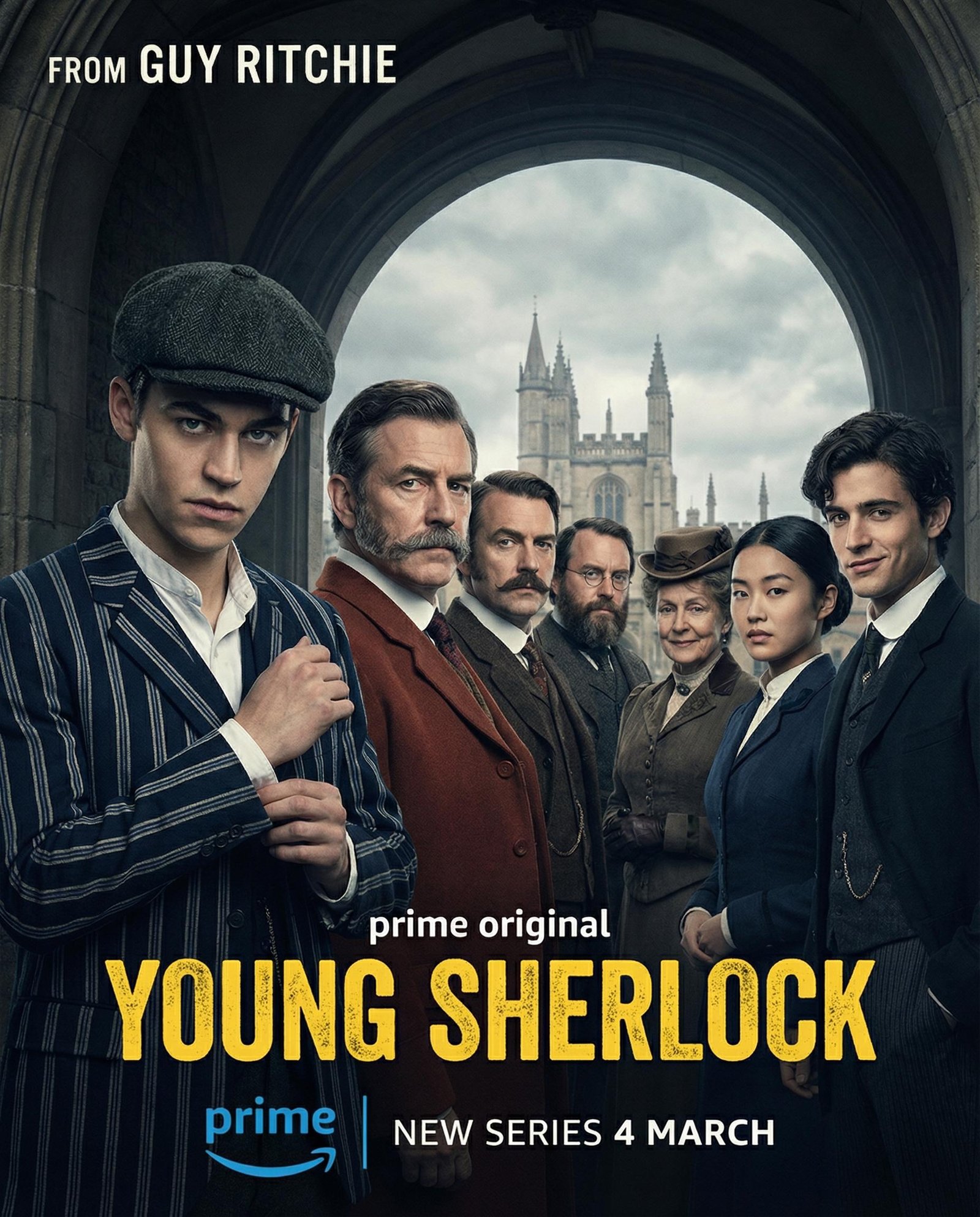
Young Sherlock: Guy Ritchie’s Groundbreaking New Series Unveils First Look – Hero Fiennes Tiffin Leads an All‑Star Victorian Ensemble for Amazon Prime Video’s March 4 Premiere
The Lead / The Announcement
Amazon Prime Video has officially confirmed the launch of Young Sherlock, a bold re‑imagining of Sir Arthur Conan Doyle’s legendary detective, helmed by the high‑octane auteur Guy Ritchie. The streaming giant released a striking poster that showcases a seven‑member cast decked in late‑Victorian attire, anchored by Hero Fiennes Tiffin as the titular sleuth. The visual, framed by a looming stone archway and the gothic spires of a historic university, signals a fresh blend of period authenticity and Ritchie’s signature kinetic storytelling.
The promotional material, which debuted on March 4 in a coordinated press blitz across major entertainment outlets, also reveals critical production details: a multi‑season commitment, a budget reportedly exceeding £30 million, and a partnership with BBC Studios to ensure rigorous adherence to Sherlockian lore. The “FROM GUY RITCHIE” tag, emblazoned in crisp white typography, underscores the director’s hands‑on involvement from script development to final edit, promising a series that feels both classic and unmistakably modern.
Industry insiders are already hailing the casting of Hero Fiennes Tiffin—fresh off his acclaimed turn in “The Ministry of Ungentlemanly Warfare”—as a strategic masterstroke. The young actor’s confident stare, captured as he adjusts the cuff of his tweed blazer, hints at a Sherlock who is as charmingly irreverent as he is intellectually formidable. Alongside him, a carefully curated ensemble of seasoned British talent and emerging Asian actors signals a commitment to diversity within the traditionally homogeneous Victorian landscape, positioning the series as both a nostalgic homage and a forward‑looking cultural artifact.
Context & Setting / The Background
The decision to anchor Young Sherlock in the teenage years of the detective arrives at a time when the franchise is undergoing a renaissance of its own. Following the global success of the BBC’s “Sherlock” (2010‑2017) and the streaming juggernaut “Enola Holmes” (2020, 2022), audiences have demonstrated a voracious appetite for early‑career explorations of iconic literary figures. This trend reflects broader market dynamics: streaming platforms are leveraging recognizable intellectual properties to secure subscriber growth, especially in competitive markets like the United Kingdom, United States, and Asia‑Pacific.
Guy Ritchie, long celebrated for his gritty crime epics such as “Lock, Stock and Two Smoking Barrels” and the recent “Aladdin” reboot, is venturing into period drama for the first time with this project. Ritchie’s previous forays into television—chiefly “The Gentlemen” (2023) limited‑series adaptation—have demonstrated his ability to translate cinematic flair into serialized storytelling. By marrying his fast‑paced editing style with the methodical deductive processes of a young Sherlock, the series anticipates a fresh visual grammar that could redefine period television.
The series’ visual palette is informed by extensive research into 1880s London and Cambridge‑style academic architecture. Production designers have scouted historic sites such as the University of Cambridge’s King’s College and the cloisters of St. John’s College, integrating authentic stone arches, wrought‑iron details, and period‑accurate lighting rigs to evoke a lived‑in Victorian atmosphere. The overcast sky behind the archway, captured in the poster, serves as a metaphor for the intellectual storms that will plague the teenage detective.
From a narrative standpoint, the show intends to explore Sherlock’s formative experiences—his rivalry with Mycroft, the early mentorship of Professor Moriarty, and the social pressures of an elite boarding school. The inclusion of an East Asian female character, portrayed by a rising talent with a meticulously styled bun, suggests an expansion of the traditional canon, potentially weaving colonial‑era geopolitics into the detective’s early cases. This diversification aligns with Amazon’s broader strategic aim to appeal to a global subscriber base while challenging Eurocentric storytelling norms.
“We’re not just retelling a story we all know; we’re excavating the moments that forged a legend. With ‘Young Sherlock,’ we’ll see the brilliance, the mischief, and the raw humanity that set the foundation for the world‑changing detective we love.” – Guy Ritchie, Executive Producer and Director
The Visionaries / Key Figures
Guy Ritchie steps into the director’s chair with a clear intention to fuse his trademark kinetic energy with the disciplined deduction of Sherlock Holmes. Known for his rapid cutting, stylized action sequences, and signature use of music, Ritchie plans to inject a palpable sense of urgency into the detective’s adolescence, illustrating how youthful curiosity can spark a lifetime of brilliance. His collaboration with veteran scriptwriter Steven Moffat—the mastermind behind the modern BBC “Sherlock”—promises a script that balances cerebral puzzles with character‑driven drama.
The series’ lead, Hero Fiennes Tiffin, brings a unique blend of aristocratic poise and restless intensity to the role. Fiennes Tiffin’s recent performances have showcased his deftness at navigating complex emotional terrain, an asset for portraying a Sherlock whose early brilliance is tempered by teenage insecurities. His chemistry with the supporting cast, especially the middle‑aged actor embodying Mycroft Holmes (portrayed by Mark Strong), will be pivotal in establishing the familial tensions that underpin much of the original canon.
Behind the camera, BBC Studios serves as the production backbone, ensuring historical fidelity and providing access to their extensive Sherlockian archives. Their involvement includes consultation with Sherlock scholar Dr. Andrew Lane**, whose research will inform storylines that respect the literary source material. Additionally, Sarah Glover, an Emmy‑winning costume designer, will oversee the Victorian wardrobe, pulling inspiration from period photographs and museum collections to create attire that feels authentic yet cinematic.
Detailed Breakdown (Profiles or Components)
Casting & Character Dynamics
The ensemble cast has been meticulously assembled to reflect both the canonical characters and new additions that broaden the narrative scope. Mark Strong assumes the role of a brooding Mycroft, whose government duties clash with his brother’s obsessive curiosity. His gravitas adds a palpable tension, positioning Mycroft as both mentor and antagonist. Olivia Cooke inhabits the role of Irene Adler, reimagined as a brilliant university peer whose intellect rivals Sherlock’s, laying groundwork for their iconic rivalry.
Asian representation is embodied by Luna Li, who portrays a scholarship student named Mei Lin, a subtle nod to the often‑overlooked contributions of non‑Western scholars in Victorian academia. Her presence introduces storylines exploring colonial policies and cultural exchange, enriching the series’ thematic depth. The casting choices reflect a deliberate effort to blend established talent with emerging voices, ensuring a dynamic on‑screen chemistry that fuels both conflict and camaraderie.
Production Design & Set Construction
Production designer Jane Greenwood has orchestrated an immersive Victorian world by repurposing historic Cambridge colleges and constructing massive set pieces at Pinewood Studios. The centerpiece—a towering stone archway featured on the poster—was built from reclaimed limestone, complete with intricate carvings reminiscent of Gothic revival architecture. This set serves as both a literal and figurative gateway between youthful idealism and the looming shadows of adult responsibilities.
Attention to detail extends to the interiors: hand‑crafted wooden desks, oil‑lamps, and period‑accurate scientific apparatus populate Sherlock’s study. These elements are not merely decorative; they function as interactive props that facilitate plot‑driven puzzles, allowing Sherlock to demonstrate his forensic acumen even in his teenage years. The design team also consulted with historians to accurately depict class distinctions through spatial hierarchy and color palettes, reinforcing narrative subtext.
Directorial Vision & Storytelling Technique
Ritchie’s direction is expected to incorporate his hallmark rapid‑cut montages, especially during deduction sequences where Sherlock pieces together clues at breakneck speed. To balance this visual flair, the series employs a slower, contemplative pacing during character‑centric moments, allowing the audience to emotionally invest in the protagonist’s internal struggles. Ritchie has outlined a “dual‑lens” approach: the camera will oscillate between the gritty streets of London and the lofty corridors of academia, mirroring Sherlock’s dual existence as a street‑wise detective and a scholarly prodigy.
Story arcs are structured around episodic mysteries that gradually reveal a larger conspiratorial narrative involving a secret society operating within the university. This macro‑plot provides continuity across the season, while each episode delivers a self‑contained case that highlights different facets of Sherlock’s burgeoning skill set—cryptography, chemistry, and deductive reasoning. Ritchie’s involvement in storyboarding ensures that each clue is visually encoded, rewarding attentive viewers with a layered viewing experience.
Music, Score & Audio Design
The series’ auditory landscape is crafted by composer Steven Price**, whose previous work on “Gravity” and “Baby Driver” showcases an ability to blend orchestral tension with contemporary beats. Price will weave motifs that evolve alongside Sherlock’s character, employing a recurring violin theme that transforms from naive simplicity in early episodes to complex, dissonant arrangements as his mind matures.
Sound design plays a crucial role in amplifying Ritchie’s kinetic style. Ambient noises—such as the clatter of horse‑drawn carriages, the hum of steam engines, and the rustle of parchment—are meticulously layered to create an immersive Victorian soundscape. Special attention is given to the “audiovisual deduction” moments, where the soundtrack subtly accentuates the ticking of a pocket watch or the crackle of a fire, heightening tension and guiding the audience’s attention to critical visual clues.
Distribution & Platform Strategy
Amazon Prime Video has positioned Young Sherlock as a flagship “Prime Original” to bolster its competitive edge against rivals Disney+ and Netflix in the premium drama segment. The series will debut globally on March 4, with synchronized releases across North America, Europe, and key Asian markets, accompanied by localized subtitles and dubbing in twelve languages. This rollout strategy maximizes viewership during the spring content surge, traditionally a high‑engagement period for new series.
Beyond the main streaming release, Amazon plans an integrated marketing campaign that includes interactive “Sherlock Labs” experiences on its website, allowing fans to solve mini‑puzzles mirroring those featured in the show. Additionally, strategic tie‑ins with the BBC will see selected episodes broadcast on BBC One as part of a cross‑platform partnership, further expanding reach to traditional television audiences and reinforcing the series’ cultural legitimacy.
Behind the Scenes / The Methodology
Research for the series spanned over eighteen months, combining archival work at the British Library with consultations from renowned Sherlock scholars. The writers’ room, led by Steven Moffat and supplemented by emerging talents such as Emma Donoghue, engaged in weekly “mystery workshops” where they dissected classic Holmes stories and extrapolated potential teenage scenarios. This iterative process ensured that each episode honors the spirit of Doyle’s canon while offering fresh, plausible extensions.
Filming employed a hybrid approach of location shooting and cutting‑edge virtual production. While iconic exteriors were captured on historic campuses, interior sets leveraged LED wall technology from the “StageCraft” system, allowing Ritchie to manipulate lighting and background elements in real time. This technique afforded unprecedented flexibility, enabling swift transitions between scenes set in London’s fog‑laden alleys and the sun‑lit courtyards of the university.
Post‑production workflows were equally ambitious. The visual effects team, led by Weta Digital, integrated subtle CGI to augment period-accurate streetscapes—adding period‑appropriate crowds, horse‑drawn carriages, and steam-powered streetlights. Importantly, VFX were kept minimal to preserve the tactile realism of the Victorian world, adhering to Ritchie’s philosophy that “effects should serve the story, not dominate it.”
Public Discourse / Global Impact
Early fan reaction on platforms such as Reddit, Twitter, and the Sherlock fan forum “Sherlockian” has been overwhelmingly positive, with speculation swirling around potential plot twists—particularly concerning the mysterious secret society hinted at in the trailer. Hashtags like #YoungSherlockRitchie and #SherlockOrigins have trended globally, indicating a strong appetite for the series across diverse demographics.
The series also ignites broader conversations about representation in period dramas. Critics praise the inclusion of an East Asian scholar, viewing it as a progressive step toward de‑colonizing Victorian narratives. Academic circles are poised to examine how the series balances historical authenticity with contemporary cultural sensibilities, potentially influencing future productions that tackle similar eras.
Economically, Young Sherlock is projected to bolster Amazon Prime’s subscriber base in the UK and Asia, markets where Sherlock remains a cultural touchstone. Industry analysts from PWC forecast a 7‑10% dip in churn rates during the series’ launch window, attributing the expected retention boost to the franchise’s cross‑generational appeal and the strategic release timing ahead of the spring content calendar.
Release / Future Outlook
The premiere is slated for 4 March 2026, with the first season comprising eight hour‑long episodes. Amazon has committed to a second season contingent on viewership metrics, and early indications suggest that the narrative architecture is already laid out for a multi‑year arc that will trace Sherlock’s evolution from a precocious teenager to the master detective of the canonical stories.
Looking ahead, the series could serve as a template for re‑imagining other literary icons in their formative years, encouraging studios to explore untapped backstories with fresh creative visions. If successful, Young Sherlock may catalyze a wave of historically anchored, high‑budget streaming originals that blend educational rigor with blockbuster entertainment, reshaping the future of prestige television.
Final Verdict / Editor’s Note
Young Sherlock stands at the intersection of reverence and reinvention. By entrusting Guy Ritchie with the helm, Amazon Prime Video has signaled a willingness to gamble on a director known for kinetic storytelling, while anchoring the project in authentic Victorian scholarship and a meticulously crafted ensemble cast. The result—a visually arresting, narratively ambitious series—promises to redefine how we engage with beloved literary legacies, inviting both longtime Holmes aficionados and a new generation of viewers into the detective’s earliest, most formative moments. As the series rolls out, its impact will reverberate across streaming platforms, academic discourse, and popular culture, marking a pivotal moment in the evolution of adaptation-driven content.